
Make It Stop!

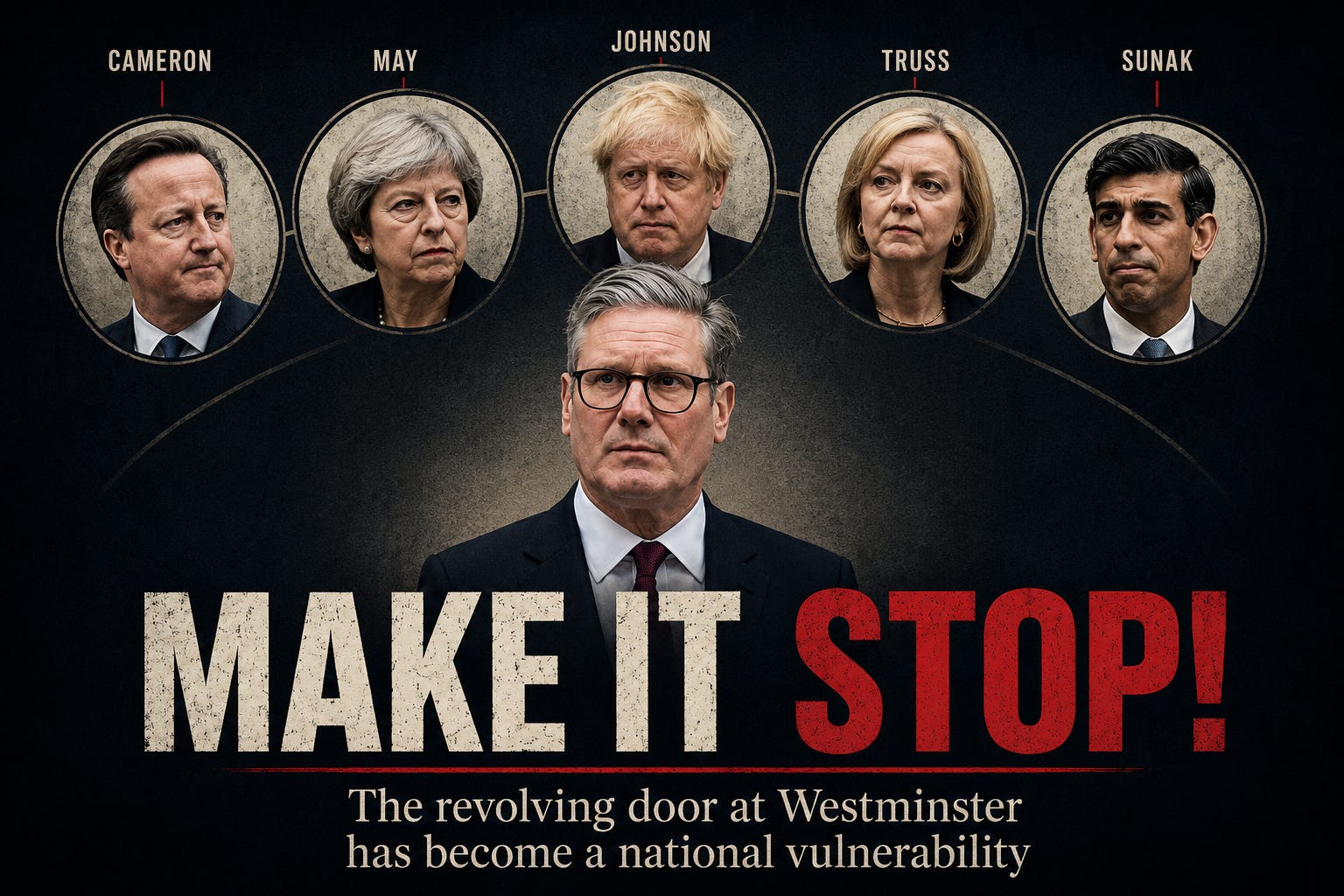
It’s hard to fathom how a government that won a landslide majority is already flirting with self-destruction less than halfway through its term of office, yet here we are. Labour has been plunged into chaos by fevered speculation about the Prime Minister’s future following a predictably poor set of local election results. The crisis has already triggered four junior ministerial resignations, alongside a growing exodus of parliamentary aides, backbench dissent, and one cabinet resignation - more on Wes Streeting shortly.
Labour campaigned on the promise of ending a relentless cycle of Westminster psychodrama. And, for a while at least, Sir Keir Starmer’s steady, if rather uninspiring, style felt faintly reassuring after the tumult of the Tory years. However, a series of policy missteps and a climbdown over attempts to control soaring welfare costs have inevitably raised questions about Starmer’s leadership.
The legitimacy of those questions partly explains the media frenzy now engulfing Westminster. Some blame the media itself for fuelling the chaos, but that rather misses the point. The media is doing what it has always done, gravitating towards conflict, personality and uncertainty because that is where the strongest stories usually lie. The bigger problem is that social media now amplifies every wobble, every rumour and every emotional reaction in real time, creating a vicious circle of speculation, outrage and panic.
Added to this is the uncomfortable reality that hostile actors deliberately feed disinformation into these platforms to deepen division and undermine public trust - something still remarkably underreported in Britain. We have not yet learned to recognise this environment for what it is. Instead, round and round we go, searching for simple solutions to problems that are, in reality, immensely complicated and would test a government of any political colour.
Britain has suffered two colossal shocks in the space of a decade that have left the country poorer, more divided and strategically diminished: Brexit and the global pandemic. On top of that, the current government is grappling with the fragmentation of the global trading system, wars in Ukraine and the Middle East, and the geopolitical upheaval created by a second Trump presidency with profound consequences for European and British security.
Any government would struggle under that weight.
That does not mean Labour, or Keir Starmer, are beyond criticism - far from it. Governments make mistakes. Policies fail. Communications go wrong. Leaders disappoint. That is politics. But there is a growing tendency in modern democracies to convince ourselves that replacing one leader with another will somehow make deep structural problems magically disappear.
It rarely works that way. What matters is having capable people focused on workable solutions.
Starmer’s supporters would argue that, despite his faults, he has at least brought a degree of calm professionalism back to government after years of noise and instability. He has rebuilt working relationships in Europe at a time when Brexit left them badly strained, while also navigating a rapidly deteriorating transatlantic relationship with greater caution than some critics acknowledge. A change in leadership now risks undoing those efforts. His refusal to be dragged into another open-ended military adventure without a clear strategic framework was, whatever one’s politics, a sign of a functioning government making sober calculations rather than emotional ones.
And so we come to Wes Streeting.
Was his resignation the act of a principled politician who had genuinely lost confidence in the Prime Minister’s ability to govern? Possibly. But politics is also a profession consumed by ambition. That Streeting resigned without immediately mounting a formal leadership challenge rather suggests he either lacked the numbers or concluded the timing was not yet right.
Streeting’s suggestion that Britain should ultimately seek to rejoin the EU may appeal to many who believe Brexit was a profound strategic error. But it also risks reopening one of the deepest political wounds in modern Britain before the country has rebuilt the trust, stability or economic strength needed for such a debate. Closer European cooperation is essential, not least on trade and security, but rejoining on worse terms than Britain previously enjoyed would carry its own political and economic costs. Starmer understands this, and his policy of slowly rebuilding trust may be boring, but our relationship with EU leaders has clearly been improving. Political upheaval now risks undoing that work - EU capitals are hardly likely to place much faith in a country that still appears unable to decide what kind of state it wants to be.
As for Andy Burnham - frequently presented as Labour’s potential saviour - his path to Number Ten is hardly straightforward either. Before he can even contemplate leading the country, he would first have to return to Westminster by winning a parliamentary seat at a moment when Reform is making significant inroads into Labour heartlands.
None of this is unusual. Achieving high office has always been the fuel of political life. But the public should at least recognise that much of what is now unfolding is not solely driven by duty to country. It is also driven by calculation, positioning and naked ambition.
That matters because Britain is operating in an increasingly fragile world. Thirty-year gilt yields touched 5.81% this week - their highest level in almost thirty years. Some of this reflects global inflation and energy fears, but the Westminster crisis has clearly become part of the risk premium now attached to Britain. European security is under pressure. Public finances are stretched. Social cohesion is fraying. In those circumstances, permanent political warfare carries risks of its own.
This is where the issue stops being merely political and becomes strategic. Britain’s adversaries do not need to create our instability from scratch. They only need to identify existing fractures, amplify them, and wait while trust in institutions erodes from within. A country permanently consumed by leadership speculation, fiscal anxiety and culture-war grievance is a country less able to deter, prepare, invest or lead.
Britain may yet decide Keir Starmer is not the right man for the moment. He may decide it is no longer worth the candle. But the country should at least recognise the scale of the problems it faces before convincing itself that replacing one leader with another will magically make them disappear.
The danger is that Britain has become trapped in a cycle where governments are given remarkably little time to solve remarkably difficult problems. In an age of economic fragility, geopolitical instability and information warfare, permanent political psychodrama carries a cost of its own.
Wise words, Rod. If Burnham wins the seat, Streeting may well not stand. Rayner and Miliband would beat him in a leadership contest, according the the latest Labour List Survation Poll.